
Best GitHub-native value
GitHub CopilotSee GitHub Copilot plansCategoryAI Coding Assistants
AI Coding Assistants
Updated June 29, 2026: compare Cursor, Claude Code, GitHub Copilot, Amazon Q Developer's Kiro transition, Gemini Code Assist and Antigravity, MiniMax-M3, DeepSeek V4, Grok Build, Mastra, Pydantic AI, BAML, DSPy, Instructor, Mirascope, Outlines, Inspect AI, Guardrails AI, LM Evaluation Harness, OpenAI Evals, Chainlit, Agno, Respan, LiteLLM, LlamaIndex, Haystack, promptfoo, Braintrust, DeepEval, Ragas, OpenPipe, Arize Phoenix, Traceloop, LangWatch, Patronus AI, Codex, Devin, v0, Replit Agent, Aider, Cline, CodeRabbit, Cody, and Augment by workflow, pricing, autonomy, model-route risk, and team fit.
8.3/10Strong
Best AI-native IDE
Monthly$0-$120+/user/monthAnnualEnterprise custom
Best AI-native IDE
Cursor
AI-native code editor on a VS Code fork with Tab, Composer 2.5, the Agents Window, Cloud Agents, Automations, Bugbot, and plan-dependent model access.
Editorial · no paid placements
Quick paths
Best terminal coding agent
Claude CodeSee Claude Code plansBuyer path
Source-backed shortlist
EvidenceCursor pricing
- Source
- Registered source
- Freshness
- Review due
- Confidence
- Low confidence
Best IDE-native coding agent
CursorCursor remains the strongest fit when the buyer wants editor-native coding, agent tasks, and codebase-aware workflows in one product.
EvidenceCursor pricing
- Source
- Registered source
- Freshness
- Review due
- Confidence
- Low confidence
- Verified
Best GitHub-native enterprise default
GitHub CopilotGitHub Copilot is the safer default when procurement wants GitHub-native governance, IDE coverage, code review, and agent tasks inside existing GitHub controls.
EvidenceGitHub Copilot plans
- Source
- Registered source
- Freshness
- Review due
- Confidence
- Low confidence
- Verified
Best typed Python agent framework
Pydantic AIPydantic AI is the better shortlist when Python teams want typed agents, structured outputs, dependencies, tools, MCP, evals, graph workflows, and provider choice without adopting a hosted app builder.
EvidencePydantic AI docs index
- Source
- Registered source
- Freshness
- Current
- Confidence
- High confidence
- Verified
Best typed LLM function layer
BAMLBAML is the better shortlist when engineering teams want typed LLM functions, generated clients, robust parsing, tests, streaming, multimodal inputs, and Boundary Studio traces tied to code.
EvidenceBAML introduction
- Source
- Registered source
- Freshness
- Current
- Confidence
- High confidence
- Verified
Best LLM program optimization framework
DSPyDSPy is the better shortlist when developers have repeatable LLM tasks, examples, and metrics that can guide signatures, modules, and optimizers instead of hand-tuned prompt sprawl.
EvidenceDSPy program, don't prompt guide
- Source
- Registered source
- Freshness
- Current
- Confidence
- High confidence
- Verified
Best structured-output library
InstructorInstructor is the better shortlist when developers need validated JSON, Pydantic-style schemas, retries, and provider adapters inside application code.
EvidenceInstructor docs
- Source
- Registered source
- Freshness
- Current
- Confidence
- High confidence
- Verified
Best provider-agnostic LLM SDK
MirascopeMirascope is the better shortlist when developers want typed provider-agnostic calls, tools, structured outputs, streaming, async workflows, agents, and OpenTelemetry-friendly observability hooks.
EvidenceMirascope docs
- Source
- Registered source
- Freshness
- Review due
- Confidence
- Low confidence
- Verified
Best constrained-generation library
OutlinesOutlines fits developers who need JSON Schema, regex, grammar, or typed-schema constraints during generation instead of relying only on post-hoc JSON repair.
EvidenceOutlines docs
- Source
- Registered source
- Freshness
- Review due
- Confidence
- Low confidence
- Verified
Best custom coding-agent eval framework
Inspect AIInspect AI is the stronger coding-adjacent shortlist when developers need code-defined eval tasks, scorers, tools, agents, sandboxes, and Inspect View for coding or agent behavior.
EvidenceInspect AI docs
- Source
- Registered source
- Freshness
- Current
- Confidence
- High confidence
- Verified
Best runtime LLM validation layer
Guardrails AIGuardrails AI fits coding teams that need validators, Pydantic-style structured outputs, on-fail policies, Hub validators, and input/output guards before app code trusts model results.
EvidenceGuardrails quickstart
- Source
- Registered source
- Freshness
- Current
- Confidence
- High confidence
- Verified
Best standardized model benchmark harness
LM Evaluation HarnessLM Evaluation Harness fits coding-model evaluations that need reproducible benchmark coverage across local weights, APIs, vLLM, SGLang, Hugging Face, and OpenAI-compatible routes.
EvidenceLM Evaluation Harness README
- Source
- Registered source
- Freshness
- Current
- Confidence
- High confidence
- Verified
Best quick Python chat UI framework
ChainlitChainlit fits teams that need a fast conversational AI interface for prototypes, demos, internal tools, RAG workflows, or agent UI review before productizing.
EvidenceChainlit docs
- Source
- Registered source
- Freshness
- Review due
- Confidence
- Low confidence
- Verified
Best LLM app security test harness
promptfoopromptfoo is the stronger shortlist when coding teams need local evals, red-team probes, vulnerability scans, guardrails, MCP proxy checks, and AI security testing before release.
Evidencepromptfoo pricing
- Source
- Registered source
- Freshness
- Review due
- Confidence
- Low confidence
- Verified
Best code-first RAG evaluation framework
RagasRagas is the better shortlist when developers need open-source metrics, synthetic test data, experiments, and cost-aware eval loops in code for LLM or RAG features.
EvidenceRagas docs
- Source
- Registered source
- Freshness
- Current
- Confidence
- High confidence
- Verified
All tools in AI Coding Assistants
- 1
 GitHub CopilotGitHub-native AI pair programmer across IDEs, GitHub, CLI, code review, Spaces, Spark, and cloud Coding Agent workflows, now governed by GitHub AI Credits.
 - 2
 Claude CodeAnthropic's agentic coding product for terminal, IDE, desktop, browser, and remote codebase work. Included with paid Claude plans; Max tiers scale sustained usage.
 - 3
 OpenAI CodexOpenAI's agentic coding product. Cloud-async coding agent, Codex Desktop app, CLI, IDE extensions, Chrome extension, and now ChatGPT mobile control for active coding-agent work.
 - 4
 CursorAI-native code editor on a VS Code fork with Tab, Composer 2.5, the Agents Window, Cloud Agents, Automations, Bugbot, and plan-dependent model access.
 - 5
 DSPyMIT-licensed framework from Stanford for programming, optimizing, and evaluating language-model systems with signatures, modules, metrics, optimizers, agents, and structured inputs/outputs.
 - 6BAMLApache-2.0 language and toolchain from BoundaryML for typed LLM functions, generated clients, structured outputs, robust parsing, tests, streaming, multimodal inputs, and Boundary Studio traces.
- 7
 InstructorMIT-licensed structured-output library for getting validated JSON from LLMs with Pydantic-style models, retries, and provider adapters.
 - 8
 MastraTypeScript framework and platform for building AI agents, workflows, RAG, memory, evals, and production APIs. Apache 2.0 framework; paid platform starts at Teams $250/month plus usage meters.
 - 9
 Pydantic AIMIT-licensed Python agent framework from the Pydantic team, built around typed agents, structured outputs, tools, dependencies, MCP, evals, graph workflows, and Logfire observability.
 - 10
 ZedNative Rust code editor with GPU rendering, real-time multiplayer, and the open-weight Zeta2.1 edit-prediction model. Free for individuals.
 - 11
 ContinueOpen-source coding agent acquired by Cursor. The final 2.0.0 release remains available as CLI, VS Code extension, and JetBrains plugin, but the repository is read-only and no longer actively maintained.
 - 12
 DevinCognition AI's autonomous software engineer. Delegates tickets inside a sandboxed shell, browser, and editor and ships a pull request.
 - 13
 KiroSpec-driven agentic IDE and CLI that turns prompts into requirements, design docs, task lists, code, tests, and documentation. Free tier plus $20, $40, $100, and $200 monthly plans.
 - 14
 MirascopeMIT-licensed provider-agnostic SDKs for typed LLM calls, tools, structured outputs, streaming, agents, and OpenTelemetry-friendly observability.
 - 15
 OutlinesApache-2.0 structured-generation library from .txt for constraining LLM output to JSON Schema, regex, grammars, and typed schemas during generation.
 - 16
 TraeByteDance's AI-first IDE. VS Code fork with SOLO autonomous agent, multi-model backbone (Claude, GPT, DeepSeek, Gemini), and aggressive $3-$10 pricing that undercuts Cursor and Windsurf.
 - 17
 AiderFree open-source CLI pair-programmer. Edits real files in your git repo, auto-commits each change, works with any LLM via BYOK.
 - 18
 Amazon Q DeveloperAWS-native AI coding assistant for existing Q Developer customers, with IDE plugins transitioning to Kiro by April 30, 2027.
 - 19
 AntigravityGoogle's agentic development platform, now spanning Antigravity 2.0, Antigravity CLI, Antigravity SDK, and Antigravity IDE on a shared agent harness.
 - 20
 Augment CodeCodebase-aware AI coding platform with Agent, Cosmos, Auggie CLI, MCP/native tools, Code Review, and Business pricing at $100/month for up to 50 seats.
 - 21
 ClineOpen-source coding agent runtime for IDE, terminal, Kanban, SDK, and licensed Spec Driven enterprise workflows. Free for individual developers, with usage-based inference and Enterprise governance.
 - 22
 CodeRabbitAI code review platform for pull requests, IDE reviews, CLI reviews, CodeRabbit Plan, and Slack agent workflows. Pro is $24/user/month annual; Pro+ is $48/user/month annual.
 - 23FactoryAI-native software development platform built around Droid agents for CLI, desktop, SDK, code review, QA, missions, Slack, Linear, GitHub, and enterprise deployments.
- 24
 Val TownBrowser-based serverless TypeScript runtime. Write a val, click run, ship a live HTTP endpoint or cron job in minutes.
 - 25
 JetBrains AI AssistantNative AI for the JetBrains IDE family plus Junie, the agentic coding agent, priced per credit on AI Pro and AI Ultimate.
 - 26
 Pieces for DevelopersLocal-first AI memory layer for developers. Captures, enriches, and resurfaces code snippets and context across IDEs, browser, and terminal.
 - 27
 QodoAI code review platform for pull requests, IDE review, credit-based team review, context-aware rules, and enterprise SDLC governance.
 - 28
 Replit AgentReplit's browser-based AI app builder. Current docs frame Agent around plain-language app creation, Lite/Economy/Power modes, High effort, Turbo, Design Canvas, self-testing, web search, skills, and task workflows.
 - 29
 Windsurf / Devin DesktopCognition's AI-native IDE surface formerly branded Windsurf. Now presented publicly as Devin Desktop with Cascade-style editing, SWE-1.6 models, adaptive routing, and Devin stack integration.
 - 30
 OpenHandsOpen-source AI software engineer (formerly OpenDevin). MIT-licensed CLI, GUI, and SDK that autonomously write and test code in a Docker sandbox with any LLM.
 - 31
 TabninePrivacy-first AI code assistant. Runs on-device, self-hosted, or air-gapped. Trained on permissively licensed code to cut IP risk.
 - 32BLACKBOX AIMulti-model AI coding platform with chat, app builder, coding agent across 35+ IDEs, terminal/web workflows, voice agent, cloud, CLI, API, mobile, and low-cost paid plans.
- 33
 ChainlitApache-2.0 Python framework for building conversational AI interfaces, prototypes, and internal chat apps around LLM workflows.
 - 34
 CodySourcegraph Enterprise code intelligence plus AI, no longer a self-serve coding assistant after the July 2025 Free/Pro sunset.
 - 35
 Same.devBrowser-based AI app builder for prompt- and URL-based web apps. It clones existing designs, previews in the browser, deploys through Same's hosted flow, and runs on token-metered pricing from free through $100 Ultra.
 - 36
 SupermavenFastest AI autocomplete in the category. Babble model ships a 1M-token context window at sub-250ms latency.
 - 37
 CodeiumAI code completion brand from 2022 to 2025. Codeium became Windsurf, and Windsurf is now publicly presented as Devin Desktop inside Cognition's coding-agent stack.
 - 38
 LocofyDesign-to-code platform that turns Figma, Adobe XD, and Penpot files into React, Next.js, React Native, Flutter, and Vue code, now with a Figma-to-Cursor/Claude Code agentic layer and MCP server.
 - 39
 ClaudeAnthropic's AI assistant. Strongest on long-context reasoning, agentic coding, and long-form writing.
 - 40
 Hugging FaceOpen AI collaboration hub for models, datasets, Spaces, inference endpoints, evaluations, and enterprise ML workflows.
 - 41
 WhisperOpenAI's open-weights speech-to-text baseline. MIT-licensed code and weights remain useful for self-hosted batch transcription, while OpenAI's newer hosted transcription models now handle the higher-accuracy and diarization paths.
 - 42LiteLLMOpen-source LLM gateway and Python SDK for one OpenAI-compatible interface across 100+ model providers, with routing, virtual keys, spend tracking, guardrails, MCP, and enterprise controls.
- 43
 promptfooOpen-source LLM evaluation, red teaming, vulnerability scanning, guardrails, model security, MCP proxy, code scanning, and enterprise AI security testing.
 - 44
 LlamaMeta's open-weight LLM family. Llama 4 Maverick remains the flagship open-weight choice; Scout is the long-context and Groq-hosted fast lane; Behemoth remains an internal teacher model.
 - 45
 LlamaIndexOpen-source framework and managed LlamaCloud stack for building LLM agents over private data, RAG, document parsing, extraction, indexing, retrieval, workflows, and context augmentation.
 - 46
 Arize PhoenixOpen-source AI observability, tracing, evaluation, prompt engineering, experiments, and Arize AX hosting for teams improving LLM systems.
 - 47
 BraintrustAI evaluation, tracing, prompt playground, datasets, experiments, monitoring, human review, and observability infrastructure for teams shipping LLM products.
 - 48
 GleanEnterprise work AI platform combining permission-aware search, assistant, agents, connectors, APIs, and MCP access to company knowledge.
 - 49
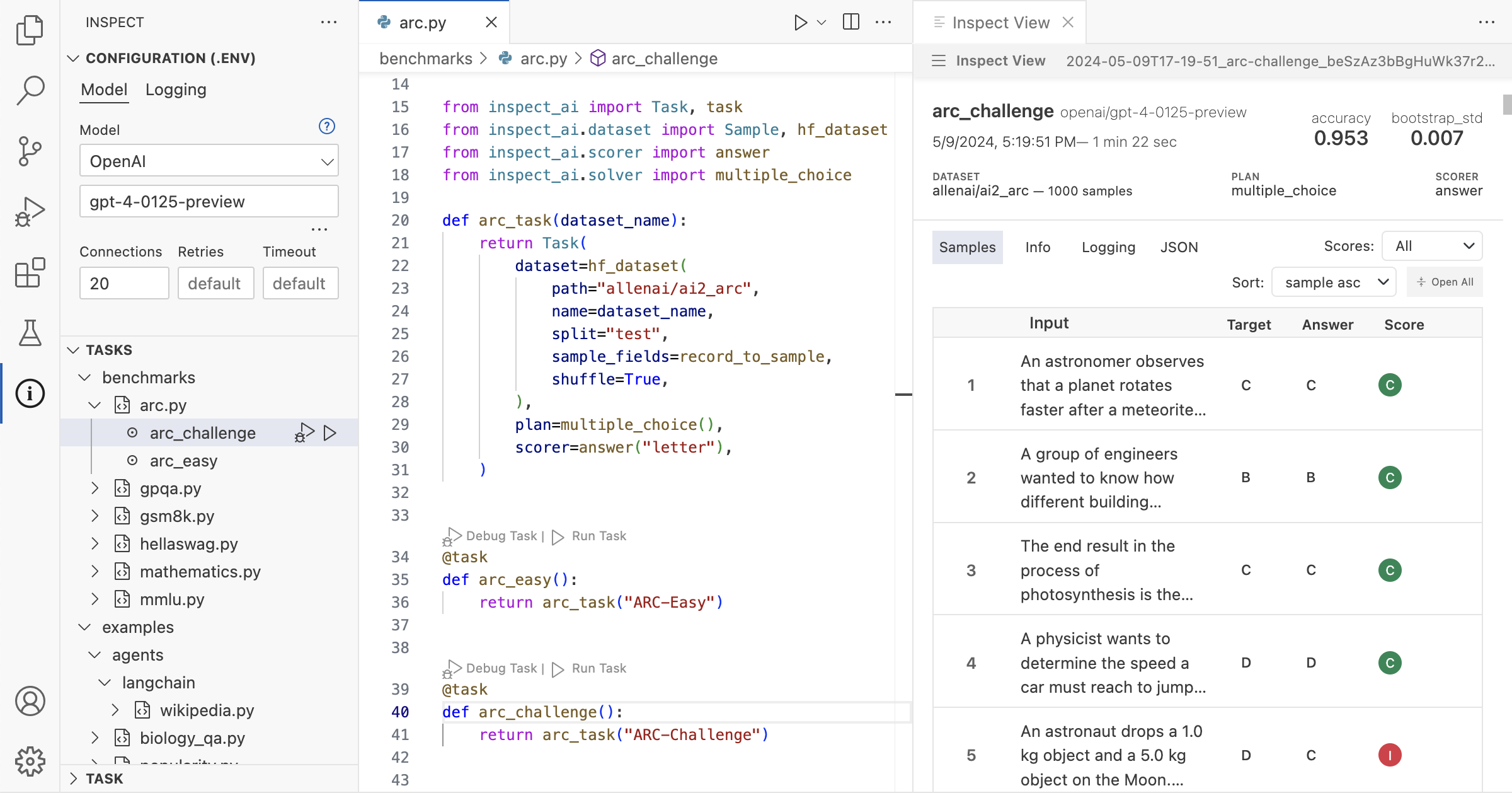 Inspect AIMIT-licensed evaluation framework from the UK AI Security Institute and Meridian Labs for coding, agent, reasoning, knowledge, behavior, and multimodal model evals.
 - 50
 LangSmithLangChain's hosted agent and LLM observability platform for tracing, monitoring, evaluation, prompt workflows, deployment, sandboxes, Fleet agents, and Engine optimization.
 - 51
 LM Evaluation HarnessMIT-licensed EleutherAI framework for running standardized language-model benchmarks across local models, APIs, vLLM, SGLang, Hugging Face, and leaderboard tasks.
 - 52
 ModalServerless cloud for Python, GPUs, jobs, web endpoints, sandboxes, queues, and AI apps that should scale without managing infrastructure.
 - 53
 PortkeyLLM gateway, observability, prompt management, routing, guardrails, governance, caching, and cost controls for production AI applications.
 - 54
 Together AIAI infrastructure platform for serverless inference, dedicated GPU deployments, fine-tuning, code sandboxes, and open-model training workflows.
 - 55
 BrowserbaseCloud browser infrastructure for agents, scraping, QA automation, and web data workflows that need managed Chromium, Fetch, Search, identity, runtime, and observability.
 - 56
 DeepEvalOpen-source LLM evaluation framework from Confident AI for metrics, test cases, RAG evals, agent evals, tracing, datasets, and CI-friendly quality gates.
 - 57
 HaystackApache-2.0 AI orchestration framework from deepset for production LLM apps, RAG systems, agents, multimodal search, reusable components, pipelines, tools, and document stores.
 - 58
 OpenRouterUnified LLM API for hundreds of models, with OpenAI-compatible requests, provider routing, fallbacks, app attribution, and per-model token pricing.
 - 59QwenAlibaba Cloud's Qwen model family spans Qwen Studio, Qwen Cloud APIs, hosted Qwen3.7-Max, qwen3.7-plus, and Apache 2.0 open-weight Qwen3 releases from 0.6B through 235B MoE.
- 60
 RagasOpen-source evaluation framework for LLM apps, RAG systems, metrics, synthetic test data, experiments, and cost-aware eval loops.
 - 61
 ReplicateDeveloper platform for running open and hosted AI models by API, with official models, community models, custom deployments, and usage-based pricing.
 - 62
 AgnoApache-2.0 agent platform SDK and AgentOS control plane for building, running, observing, and managing production agent systems in your own stack.
 - 63
 DeepSeekOpen-weight Chinese LLM lab offering frontier reasoning and chat at fractions of OpenAI frontier-model pricing.
 - 64
 LangWatchOpen-source LLMOps platform for traces, evaluations, datasets, AI gateway workflows, DSPy optimization, self-hosting, and monitoring.
 - 65
 OpenLITApache-2.0, OpenTelemetry-native LLM observability platform for traces, metrics, costs, prompts, evals, dashboards, and GPU monitoring.
 - 66
 OpenPipeFine-tuning, request logging, datasets, evaluations, DPO, and hosted inference for turning expensive prompts into cheaper specialized models.
 - 67
 OpikOpen-source and hosted AI observability and evaluation platform from Comet for agent traces, test suites, LLM-as-judge metrics, and production monitoring.
 - 68
 Patronus AIAI evaluation and simulation infrastructure for LLM apps, agent debugging, evaluators, traces, datasets, prompts, guardrails, and Digital World Models.
 - 69
 TraceloopOpenTelemetry-based LLM observability and evaluation platform built on OpenLLMetry for traces, quality checks, prompt management, experiments, and enterprise AI monitoring.
 - 70
 Base44Wix-owned AI app builder for React/Vite apps with managed NoSQL, auth, backend functions, integrations, custom domains, and Builder-tier GitHub sync.
 - 71
 ComposioTool-calling and MCP infrastructure for AI agents, with 1000+ app toolkits, managed authentication, session tools, hosted MCP URLs, and usage-based pricing.
 - 72
 Guardrails AIApache-2.0 guardrails framework and Hub for validating, structuring, and quality-controlling LLM inputs and outputs with reusable validators.
 - 73
 Julius AIData analysis workspace that turns files, notebooks, databases, and Slack questions into Python, SQL, charts, slides, and scheduled reports.
 - 74
 ManusGeneral-purpose autonomous agent that researches, codes, builds spreadsheets, and operates the web in a sandboxed VM, with June 2026 ownership and continuity risk around the Meta unwind.
 - 75
 RespanLLM engineering platform, formerly Keywords AI, for observability, evals, prompt management, and an OpenAI-compatible gateway across many model providers.
 - 76
 UizardMiro-owned AI UI design tool for fast editable mockups. Autodesigner 2.0 turns prompts into prototypes, while Screenshot Scanner and Wireframe Scanner turn references into editable screens.
 - 77
 GumloopYC W24 drag-and-drop AI workflow builder for marketing and ops teams. Free 5K credits, Pro $37/mo with 20K+ credits, unlimited seats, MCP hosting/proxying, and BYOK discounts.
 - 78
 KimiMoonshot AI's chatbot and model family, anchored by Kimi K2.6 with strong open-weights coding and agentic benchmarks plus Agent Swarm mode.
 - 79
 RorkAI app builder for browser-based mobile and web creation. Free builds public web apps, Rork Pro adds Android/Kotlin plus Expo/React Native, and Rork Max adds SwiftUI iOS plus Apple-device outputs.
 - 80
 RelumeAI site builder that turns a prompt into a sitemap, wireframes, and a style guide, then exports to Webflow, Figma, React, or Claude Design. Bootstrapped, ~$3.3M ARR, 1M+ users.
 - 81
 GLM (ChatGLM)Z.AI's GLM model family, with GLM-5.2 positioned for long-horizon agentic engineering, 1M context, open MIT weights, and API pricing from $1.40/M input tokens.
 - 82
 GrokxAI's AI assistant, API, Grok Build coding agent, voice, Imagine image/video, and real-time X search stack. Grok 4.3 is the current default API model with 1M context at $1.25/M input and $2.50/M output.
 - 83
 OpenAI EvalsOpenAI evaluation framework and platform for testing prompts, models, graders, and LLM app regressions, with a scheduled platform shutdown on November 30, 2026.
 - 84
 Yi (01.AI)Kai-Fu Lee's open-weight LLM family from 01.AI, kept on display while the company pivots into the WorldWise multi-agent enterprise platform.
Quick Decision
AI coding tools now split into five buyer jobs: inline help inside an existing IDE, full AI-native IDEs, terminal agents, pull-request agents, and app builders for non-developers. Pick the workflow first, then compare price.
The June 27 Cursor worth-it answer keeps the buyer rule simple: pay for Cursor only if the editor-native loop, agents, Bugbot, reviews, and usage controls are part of the daily coding workflow. Otherwise compare GitHub Copilot, Claude Code, Codex, and open/BYOK routes before adding another AI subscription.
June 15 token-budget governance update: Disney’s reported AI coding push adds a practical enterprise warning for Cursor, Claude Code, Copilot, Codex, Replit Agent, Devin, and similar tools. Do not measure rollout success by raw tokens, prompts, or agent sessions. Measure reviewed diffs, test-passing changes, defect rate, cycle time, rollback safety, and whether AI-coded work survives release.
June 15 Codex/Ona update: OpenAI’s June 11 Ona acquisition agreement makes persistent execution a first-class coding-agent buying criterion. For Codex, Claude Code, Cursor, Copilot, Devin, Replit Agent, and model-router stacks, ask where the agent runs, how credentials are scoped, how activity is logged, which actions require review, and what budget controls exist before letting background agents run for hours or days.
June 22 Grok Build update: Grok belongs in the coding-agent comparison set, not only Chatbots/Search. xAI’s current docs still describe Grok Build as an interactive TUI and headless coding agent with custom models, skills/plugins, ACP integration, and a Grok Build 0.1 API model at 256K context. Treat it as an xAI-native coding lane to benchmark, while still checking command approvals, sandbox behavior, team/ZDR retention settings, account limits, and repo-quality output before rollout.
June 23 Amazon Q Developer update: Amazon Q Developer is no longer a clean greenfield IDE/plugin purchase. AWS announced that Q Developer IDE plugins and paid subscriptions reach end of support on April 30, 2027, new Q Developer account and subscription creation was blocked starting May 15, 2026, and Kiro is the migration path for IDE/CLI work. Existing AWS-heavy teams can use the runway, but new buyers should evaluate Kiro, Cursor, Copilot, Claude Code, Codex, and other current agent surfaces before committing.
June 29 Amazon Q vs Copilot decision update: Amazon Q Developer vs GitHub Copilot now separates the real buyer lanes. Amazon Q Developer fits existing AWS-heavy teams that need continuity during the Kiro transition window. GitHub Copilot remains the cleaner greenfield default for GitHub-native IDE, pull-request, code-review, CLI, SDK workflows, as long as AI Credits and model-route policies are budgeted.
June 29 Antigravity vs Cursor decision update: Antigravity vs Cursor now separates Google’s agent harness from the general AI-native IDE default. Antigravity fits Gemini CLI migration, Google AI Pro/Ultra, Google Cloud organization access, and browser-verification workflows. Cursor remains the cleaner default when teams need a mature VS Code-like AI IDE with agents, cloud handoff, review, and usage controls.
Use Cursor when a developer wants a full AI-native IDE. The June 23 recheck keeps it the best default for daily coding when the buyer wants Composer 2.5, repo-aware chat, multi-file edits, the Agents Window, Cloud Agents, CLI/SDK automation, Design Mode, Bugbot review, and a VS Code-like surface built around AI rather than an extension. Cursor’s May 22 Gartner enterprise-coding-agent recognition is a procurement signal, but teams should still test it on their own repositories against Codex, Claude Code, and GitHub Copilot.
June 15 Cursor update: Cursor now needs a sharper buyer note around usage-sensitive agent economics and enterprise controls. The live pricing page proves Hobby free, Individual from $20/month, Teams at $40/user/month, Enterprise custom, recommends Pro+ for daily agent users plus Ultra for agent power users, and says on-demand usage can continue after included usage is consumed and be billed in arrears. The June 3-10 official updates added Enterprise organizations, SDK custom tools and auto-review, Design Mode/context usage reporting, and a faster Composer 2.5-powered Bugbot with /review before push. Treat Cursor as an editor-native agent platform, not just a Copilot replacement.
June 20 Cursor vs DeepSeek update: rates, OpenAI/Anthropic-compatible endpoints, and V4 open-weight releases, but do not replace an IDE, PR-review workflow, team admin, or compliance review.
June 20 Cursor vs Grok update: Cursor vs Grok now separates the daily AI IDE purchase from the xAI coding-agent/API evaluation lane. Cursor remains the better default for developers who need an editor, diffs, review, Cloud Agents, Automations, Bugbot, Teams controls, and usage dashboards. Grok belongs in the benchmark lane when teams want to test Grok Build, grok-build-0.1, Grok 4.3, X-aware workflows, or broader xAI platform tooling with explicit sandbox, permission, ZDR/team, and repo-quality checks.
June 27 Grok Code Fast cleanup: Grok Code Fast 1 remains a retired migration page, not a current coding-model recommendation. xAI’s May 15 retirement docs no longer make grok-code-fast-1 a standalone buy path, and the current redirect-target language needs confirmation before teams standardize on any old slug behavior.
June 20 DeepSeek vs GitHub Copilot update: DeepSeek vs GitHub Copilot now separates the low-cost model/backend purchase from the GitHub-native coding-platform purchase. DeepSeek belongs behind a model router, eval harness, internal coding agent, or self-hosted/open-weight experiment when token economics and model control matter. Copilot remains the better daily product for developers and teams because it owns IDE coverage, GitHub pull requests, code review, Copilot CLI, the generally available Copilot app, cloud Coding Agent, AI Credits budgeting, and organization policy.
June 20 DeepSeek vs Replit Agent update: DeepSeek vs Replit Agent now separates the low-cost coding-model backend from the browser app-builder purchase. Replit Agent is the better path when the buyer needs prompt, plan, build, preview, database/auth, App Testing, Skills, and publishing in one workspace. DeepSeek belongs behind an engineering-owned router, eval harness, internal agent, or self-hosted/open-weight experiment when token economics, 1M context, and model control matter more than no-code app-building speed.
June 27 Cursor-cluster update: the oldest live Cursor comparison rows now separate Cursor vs Gemini, Cursor vs Lovable, Cursor vs v0, and Cursor vs Windsurf against current primary sources. Retired adjacent-lane pages now belong in this hub, tool pages, or buyer guides unless the tools are direct substitutes for the same workflow.
Use GitHub Copilot when the team already lives in GitHub and wants a safe default. GitHub’s official billing docs keep usage-based billing with GitHub AI Credits as the active model, and the June 2 Copilot SDK GA turns Copilot into an embeddable agent runtime. It remains a strong value for GitHub-native teams that value IDE coverage, policy, pull requests, and enterprise governance, but heavy agentic, SDK, code-review, Spaces, Spark, and cloud-agent use needs modeling. The June 23 Copilot recheck keeps the DeepSeek split intact: Copilot is the GitHub-native developer workflow, while DeepSeek is the low-cost model/backend lane.
June 23 GitHub Copilot update: the Copilot page still supersedes the earlier signup-pause caveat with GitHub’s June 17 note that Student, Pro, Pro+, and Max sign-ups are reopening gradually. The current recheck keeps pricing unchanged, confirms Copilot Free’s 2,000 completions and 50 chat requests, keeps Fable 5 unavailable, adds the Opus 4.6 fast June 29 deprecation notice, and keeps MAI-Code-1-Flash expansion, AGENTS.md support in Copilot code review, and the ai_credits_used user metric in the buyer model. Keep the Fable 5 suspension warning, AI Credits budgeting, GitHub Enterprise Server caveat, one-million-token context, configurable reasoning, Agent tasks REST API, Chat/agent-session handoff, Agentic Workflows, CLI /settings, and code-review controls in the buyer model.
June 27 Copilot comparison follow-up: the refreshed GitHub Copilot vs Supermaven, GitHub Copilot vs Tabnine, and GitHub Copilot vs Val Town pages now separate Copilot’s real buyer lane from three adjacent intents: Supermaven for fast long-context autocomplete, Tabnine for privacy-first deploy-anywhere code assistance, and Val Town for hosted TypeScript vals, cron jobs, and tiny APIs.
June 5 Gemini vs Copilot update: Gemini vs GitHub Copilot now treats Gemini as the broad Google AI workspace and Copilot as the dedicated GitHub-native coding platform. Gemini can help with code explanation, architecture, Google AI Studio, Gemini CLI, and Code Assist, but Copilot remains the cleaner first purchase when the buyer needs IDE help, PR review, Coding Agent, Spaces, Spark, SDK usage, and AI Credits governance.
June 23 Antigravity migration update: Antigravity now carries the current Google developer-agent caveat: Gemini CLI, Gemini Code Assist IDE extensions, Gemini Code Assist for individuals, and Gemini Code Assist for GitHub stopped serving consumer/free/Pro/Ultra requests on June 18, 2026 and moved toward Antigravity CLI and Antigravity 2.0. Keep that separate from Gemini Code Assist Standard/Enterprise, Google Cloud organization access, and Gemini Enterprise Agent Platform.
Use Claude Code when the buyer wants a Claude-backed coding agent for serious repo work. The June 4 comparison pass clarified the real buyer split: specialist Claude agent, open-source BYOK IDE layer, async ticket delegation, GitHub-native AI platform, or hosted TypeScript runtime. Adjacent-lane pages from that pass are retired unless the tools are direct substitutes for the same workflow. Claude Code is better for repo investigation, multi-file work, command execution, debugging loops, and senior-engineer-style delegation than for passive autocomplete.
June 24 Claude Code billing correction: Claude Code buyers should treat Opus 4.8 as the stable public high-end Anthropic route unless their own account, contract, or console shows Fable/Mythos access. Do not use Fable- or Mythos-specific pilot notes as production-default evidence until the account route is actually available. Anthropic’s current Agent SDK help now points plan users back to monthly Claude credits for supported Agent SDK and Claude Code usage, while direct API usage remains separate. For coding-agent route stability across Claude Code, Codex, GitHub Copilot, and model routers, use the AI Model Availability & Churn Tracker.
Use Windsurf / Devin Desktop when the buyer wants Cognition’s IDE surface beside Devin. The June 18 recheck keeps windsurf.com/pricing routed through Devin pricing, but the page now needs to be evaluated as a current Devin Desktop stack, not a simple rename. Devin pricing still lists Free, Pro $20/month, Max $200/month, Teams $80/month plus $40/month per full dev seat, and Enterprise custom, while docs now make daily/weekly quotas, extra usage at API pricing, SWE-1.6, Devin Local, ACP, and migration/admin details central to the buyer decision.
June 18 Codeium lineage update: Codeium is now historical search intent, not a live checkout. Current buyers should compare Devin Desktop against Copilot in category/tool guidance: Cognition-stack IDE, SWE-1.6, Devin Local, local/cloud agent management, quota/extra-usage modeling, and migration-policy work versus GitHub-native IDE coverage, PRs, policy, SDK access, and AI Credits governance.
June 25 Devin comparison follow-up: the cleaned-up coding hub separates three buyer lanes cleanly: Devin for async ticket delegation, GitHub Copilot for GitHub-native IDE/PR/SDK/governance workflows, and Val Town for instant hosted TypeScript endpoints, cron jobs, and small automations. Devin pricing still shows Free, Pro $20/month, Max $200/month, Team $80/month plus $40/month per full user, and extra usage at API pricing after included usage is consumed.
June 25 Val Town update: Val Town remains the tiny TypeScript runtime lane: Free for public vals, Pro at the $21/month yearly-billed headline with $10/month in Townie credit and 2,000 private vals, and Business from $167/month yearly-billed with $100/month in Townie credit. Use Vercel or Vercel Functions when the buyer is building a full-stack app, needs multiple runtimes, or wants app-platform controls; use Val Town for vals, cron jobs, webhooks, and small internal utilities.
June 14 Factory update: Factory pricing remains unchanged in current docs: Pro is still $20/month, Plus is $100/month, Max is $200/month, and Teams/Enterprise remain custom. The buyer guidance stays conservative: Pro for serious individual evaluation, Plus only when Droid Computers or roughly 5x Pro usage are already useful, and Max only for heavy individual users who need roughly 10x Pro usage plus early access.
June 22 Mastra update: Mastra remains the TypeScript-first agent-framework lane, not a no-code app builder, retrieval storage, platform storage, LibSQL/Postgres meters, database storage, and outside model-provider spend. Current docs also make Mastra a broader production-agent surface: the model router claims 4,539 models across 133 providers, while June posts added Code Mode, Agent Signals, ACP delegation, and harness architecture guidance. Treat sandbox policy, workspace isolation, tool approvals, and provider-key handling as part of the buying decision.
June 28 Pydantic AI update: Pydantic AI is the Python agent-framework lane for teams that want typed agents, structured outputs, dependency injection, tools, MCP, evals, graph workflows, and provider choice in code. It is MIT-licensed, but production buyers should still budget for model APIs, hosting, vector stores, durable execution, secrets, observability, and review workflows.
June 28 BAML update: BAML is the typed LLM function lane for engineering teams that want generated clients, structured outputs, robust parsing, tests, streaming, multimodal or hosted governance platform.
June 28 DSPy update: DSPy is the LLM program-optimization lane for coding teams with repeatable tasks, examples, and metrics. Use it when signatures, modules, metrics, and optimizers can replace prompt sprawl. Skip it when the team has no eval signal, because optimizer runs can spend tokens while chasing the wrong behavior.
June 28 Instructor update: Instructor is the structured-output library lane for developers who need validated JSON, Pydantic-style schemas, retries, and provider adapters inside app code. Use it when extraction, classification, enrichment, or tool arguments need typed outputs. Skip it when the team needs a broader agent runtime, generated-client workflow, hosted traces, or eval operations.
June 28 Mirascope and Outlines update: Mirascope and Outlines fill two adjacent code-first LLM layers. Mirascope is the provider-agnostic SDK lane for typed calls, tools, structured outputs, streaming, async workflows, agents, and OpenTelemetry-friendly observability hooks. Outlines is the constrained-generation lane for JSON Schema, regex, grammars, and typed schemas during generation. Mirascope Cloud is discontinued, and Dottxt API public rates were not verified, so budget both as libraries first.
June 28 eval and guardrail update: Inspect AI, Guardrails AI, LM Evaluation Harness, and OpenAI Evals are coding-adjacent reliability tools, not IDE assistants. Inspect AI is the code-defined agent and safety eval framework, Guardrails AI is the runtime validation layer, and LM Evaluation Harness is the standardized benchmark lane for model comparisons. OpenAI Evals is now a migration item because OpenAI says existing hosted evals become read-only on October 31, 2026 and the dashboard/API shut down on November 30, 2026.
June 28 Agno and Chainlit update: Agno and Chainlit are coding-adjacent framework picks, not IDE assistants. Agno is the AgentOS-style platform lane for agents, teams, workflows, memory, knowledge, traces, audit logs, and interfaces. Chainlit is the quick Python conversational UI lane for prototypes, demos, internal tools, RAG, and agent workflow review. Both need engineering ownership of permissions, hosting, auth, persistence, observability, and model spend.
June 28 Respan update: Respan belongs in coding guidance when code changes alter prompts, model routes, gateway behavior, eval datasets, or production traces. It is the active Keywords AI successor surface and combines observability, evals, prompt management, monitors, spend limits, and an OpenAI-compatible gateway. Verify live Team pricing and data-handling terms before routing sensitive traffic through it.
June 28 RAG and gateway framework update: LiteLLM, LlamaIndex, and Haystack are coding-adjacent infrastructure rather than IDE assistants. LiteLLM belongs in codebases that need an OpenAI-compatible gateway and provider routing. LlamaIndex and Haystack belong when developers are building RAG, agents over private data, document pipelines, retrieval, and reusable LLM app architecture.
June 28 promptfoo update: promptfoo is the coding-adjacent test harness for LLM apps, not an IDE assistant. Use it when teams need local evals, red-team probes, vulnerability scans, guardrail tests, model security checks, MCP proxy review, code scanning, and security evidence before a coding agent or LLM feature ships.
June 28 Braintrust update: Braintrust is the eval-operations lane for coding teams shipping AI features. It belongs here when code changes alter prompts, model routes, retrieval, or agents and the team needs datasets, experiments, scores, traces, monitoring, and human review to prove the change is safer.
June 28 Ragas update: Ragas is the code-first evaluation lane for LLM and RAG features. Use it when developers need open-source metrics, synthetic test data, experiments, and cost-aware eval loops inside CI, notebooks, or test harnesses.
June 28 OpenPipe update: OpenPipe is the fine-tuning and model-optimization lane for coding teams with production logs. Use it when request logs can become datasets, fine-tuned models, DPO runs, evaluations, and hosted inference that reduce cost or latency.
June 28 DeepEval, Patronus AI, Traceloop, Arize Phoenix, and LangWatch update: DeepEval is the code-first LLM eval framework, Patronus AI is the managed reliability and Digital World Model lane, and Traceloop, Arize Phoenix, and LangWatch are coding-adjacent observability tools for AI products, not IDE assistants. Use them when code changes alter prompts, retrieval, agents, traces, evals, datasets, or release evidence.
June 24 CodeRabbit update: CodeRabbit remains the dedicated PR-review lane for teams that want AI summaries, comments, IDE/CLI review, Knowledge Base, linters, SAST hooks, and human approval before merge. The June 24 check keeps Pro at $24/developer/month annual or $30 monthly, Pro+ at $48 annual or $60 monthly, Slack Agent at $0.50 per active agent minute, and adds sharper capacity guidance: Pro, Pro+, and Enterprise review limits are refillable per-developer allowances, while usage add-on credits are $1 each and cover four reviewed files for eligible over-limit PR/CLI reviews. June changelog updates also matter for coding-agent teams: CodeRabbit Plan in VS Code, CLI v0.6.0, automatic repository linking, and newer GitLab/GHES review support.
June 22 Qodo update: Qodo remains the enterprise code-review governance lane, not an autocomplete replacement. Current pricing no longer shows the old permanent Developer free tier or $38/user/month Teams plan: every workspace starts with a 14-day trial, then Pro Team starts at $30/month with shared credits, overage caps, and support for up to 30 users. Enterprise is the route for SSO/SAML, audit logs, BYOK, advanced analytics, single-tenant SaaS, on-prem, air-gapped deployment, and negotiated contracts. Treat CLI workflows as sales-verified rather than the default reason to buy.
June 24 BLACKBOX AI update: BLACKBOX AI, multi-agent, coding-agent tier; use Pro Max for team/admin controls; treat SOC 2 Type II and ISO 27001 as in-progress audit items; and do not treat the paused Cuelinks CPC listing as an active affiliate CTA.
June 22 Replit Agent update: Replit Agent should now be evaluated as the current Agent / Agent 4-era browser app-builder surface, not the older Agent 3 session-length story. Current Replit sources keep Lite, Economy, Power, High effort, Pro/Enterprise-only Turbo, Plan Mode, Design Canvas, Web Search, Agent Skills, app self-testing, and task workflows as the buyer frame, while the newer June checks add Custom Instructions, Skills-as-SKILL.md, Package Firewall, Starter feature gates, App Testing’s web-app-only scope, and Pro credit rollover. Core remains the solo-builder upgrade and Pro is the serious Agent tier, but buyers need usage budgets because Plan Mode/text guidance, third-party API calls, App Testing, High effort, and Turbo can all raise credit burn.
June 29 BLACKBOX AI vs Replit Agent decision update: BLACKBOX AI vs Replit Agent now separates the budget multi-model coding-bundle lane from the browser app-builder lane. Replit Agent is the safer first test when the buyer wants prompt, plan, build, run, test, database/auth, publish, and iterate in one hosted workspace. BLACKBOX AI is the cheaper breadth play when a developer wants chat, App Builder, IDE, terminal, web, desktop, and multi-agent surfaces under one subscription.
June 22 Replit vs model-backend update: the new DeepSeek vs Replit Agent page makes Replit’s category lane more explicit. Replit is not the cheapest model API, and DeepSeek is not a no-code app builder. Use Replit for low-risk browser prototypes and internal apps; use DeepSeek when engineers own the backend, evaluation, privacy review, and model routing.
June 22 Claude/Replit buyer-lane update: keep Claude and Replit Agent in separate guidance unless a human narrows the buyer job. Claude is the better reasoning, repo investigation, code review, and Claude Code lane for developers working around existing codebases. Replit Agent is the better browser-native app-builder lane for non-developers, prototypes, internal tools, and small projects that need prompt, build, preview, database/auth, publish, and iteration in one workspace.
Use Codex when the team wants OpenAI-native agent coding. The June 25 check broadens the plan framing to ChatGPT Free, Go, Plus, Pro, Business, Edu, and Enterprise rather than the older Plus-and-up shortcut. It fits local repo work, PR preparation, checks, and tasks where an agent can edit and verify code rather than only suggest completions. After OpenAI’s June 11 Ona acquisition agreement, watch how Codex exposes persistent customer-controlled cloud workspaces, scoped credentials, audit logs, and review gates once the deal closes.
Use v0 by Vercel when the coding deliverable is a Vercel-native web artifact. The June 4 ChatGPT vs v0 refresh keeps the boundary clear: ChatGPT is broader for requirements, architecture, debugging, and code review, while v0 is better for generating previewable React/Next/Tailwind interfaces, deploys, GitHub sync, and PR workflows.
Use Rork when the coding deliverable is a mobile/app-store prototype instead of a web dashboard. The June 25 docs check keeps Free as a public web-app test lane, Rork Pro for Android Kotlin/Compose plus Expo/React Native and web apps, and Rork Max from $200/month for SwiftUI iOS, Apple Watch, Vision Pro, native games, and widgets. Public Rork price surfaces can conflict on the exact Pro entry point, so use checkout as the purchase source. It is an app-builder handoff lane, not a replacement for code review, mobile architecture, or production QA.
Use Goose when the buyer wants an open-source local/BYOK agent that crosses coding and general automation. The June 25 check keeps the active repository at aaif-goose/goose, with v1.38.0 as the latest checked release, Apache-2.0 code, 15+ provider routes, 70+ MCP extensions, 50,000+ GitHub stars, and no Goose subscription fee. The real cost is the configured LLM plus local permission, extension-trust, and secrets controls.
June 24 Cline update: Cline is no longer just a “free VS Code extension” buyer lane. Current Cline pages position it as an open-source agent runtime across IDE, CLI, Kanban, SDK, and a separate licensed Spec Driven enterprise platform with LG CNS. Open Source remains free for individual developers, but inference is usage-based or BYOK, and the pricing navigation now shows roughly 64k GitHub stars. Enterprise and Spec Driven are custom/licensed governance and delivery-platform lanes for SSO/RBAC/billing/audit/deployment controls, enterprise context, fixed spec pipelines, and model/deployment boundaries. Teams should review Auto Approve/YOLO plus SDK tool policies before broad automation because unlisted SDK tools default to enabled and auto-approved. Vercel AI Gateway is one supported provider route, not the whole product.
June 22 Cody update: Cody remains a Sourcegraph Enterprise-only code-intelligence lane, not a self-serve Copilot alternative. Current Sourcegraph sources still keep Enterprise starting at $16K with AI-feature credits, org-wide credit pooling, no monthly credit expiry, and renewal rollover; the VS Code Marketplace now warns Cody is no longer available for non-enterprise users even while the listing still carries stale Cody Pro/model-option copy. Evaluate it only when Sourcegraph code graph, Deep Search, MCP/API/CLI access, Cody Gateway/model controls, and enterprise procurement are part of the platform decision.
Use GLM when the coding question is model backend evaluation. Z.AI’s GLM-5.2 materials list 1M context, flexible coding effort modes, OpenAI-compatible API pricing, cached-input pricing, and MIT Hugging Face weights, with public API pricing at $1.40/M input and $4.40/M output.
Use MiniMax when the coding question is MiniMax-M3 backend evaluation. The June 21 check keeps MiniMax M3-first: standard M3 pay-as-you-go is listed at $0.30/M input and $1.20/M output for <=512K input, the M3 page positions it around coding, agentic, long-context, and native multimodal work, and >512K input plus Priority tiers still need account-level access confirmation.
Use Yi only for legacy Yi-Coder or frozen-model coding experiments. The June 10 check keeps 01.AI’s public Yi pages alive, but the company headline is WorldWise/WanZhi 2.5 enterprise agents rather than a new Yi coding-model roadmap. Teams with Yi-Coder integrated can keep it as a reproducible baseline after license review; new coding-model evaluations should start with GLM, Qwen, Kimi, MiniMax, DeepSeek, or current hosted coding assistants. The June 15 Qwen recheck matters for coding-agent buyers because Qwen Cloud still lists a June 8 Max snapshot, while qwen3.7-plus remains the clearer multimodal/GUI-agent lane and the live qwen3.7-max marketplace page still describes text input/output.
Use Llama when the coding question is open-weight model control rather than an IDE. The June 23 check keeps Maverick as the flagship open-weight model to evaluate, Scout as the long-context/Groq fast-inference lane, and Together/Groq pricing as provider-specific. It belongs here for self-hosted coding backends, local agent experiments, and model-diversification strategy, not as a direct substitute for Cursor, Copilot, Claude Code, or Codex.
Use Modal when the coding deliverable is Python-backed infrastructure, not code suggestions. Modal fits serverless Python functions, GPU inference jobs, web endpoints, sandboxes, queues, and scheduled jobs. It is a runtime/deployment lane beside Val Town and Replit-style builders, not an IDE assistant.
Use Whisper when the coding task is adding speech-to-text, not writing code. The June 10 check keeps Whisper as the MIT self-hosted batch transcription baseline, while hosted OpenAI builds should compare GPT-4o Transcribe, GPT-4o Mini Transcribe, GPT-4o Transcribe Diarize, and GPT-Realtime-Whisper by price, diarization, and latency before choosing a model ID.
Use Glean when coding agents need permission-aware company knowledge. Glean’s developer platform now exposes MCP and setup paths for Claude Code, Codex, Goose, Cursor, Gemini CLI, VS Code, Windsurf, JetBrains, and other developer surfaces, so it belongs in the enterprise-codebase-context lane rather than the autocomplete lane.
June 23 Augment Code update: Augment Code is no longer a clean $20 solo / $60 team / $200 Max comparison in the public pricing surface. The current Augment page centers Business at $100/month flat for up to 50 seats with $100 included usage, Cosmos, Auggie CLI, MCP/native tools, pay-as-you-go after included usage, and Enterprise custom. Treat Augment as a team usage-balance product, not a simple per-developer Copilot replacement. Augment’s changelog says Claude Fable 5 reached the model picker, but Anthropic’s access statement says Fable/Mythos access has been removed for all users after a US government directive, so teams must verify the live model route before using Fable-specific pilot results.
June 23 Continue acquisition update: Continue is no longer a clean paid source-controlled PR-check lane. Continue’s current homepage says Cursor acquired it, the docs describe a final 2.0.0 release, and the GitHub repository says it is read-only and no longer actively maintained. Treat Continue as an open-source coding-agent artifact to study or fork; route new managed buyers toward Cursor, GitHub Copilot, Claude Code, Cline, CodeRabbit, or Qodo by workflow.
Buyer Paths
| Buyer job | Start with | Why | Watch out |
|---|---|---|---|
| Daily AI-native IDE coding | Cursor | Strongest full-editor Copilot replacement, now with Composer 2.5, Cloud Agents, CLI/SDK automation, Design Mode, and Bugbot | Editor migration plus agent/review usage costs can disrupt teams |
| GitHub-native IDE assistance and policy | GitHub Copilot | Best fit for GitHub, VS Code, JetBrains, PRs, cloud agents, and enterprise controls | AI Credits, Fable 5 suspension, paid-plan eligibility, GitHub Enterprise Server unavailability, long-context/reasoning costs, and Actions-backed review/agent controls need modeling before heavy use |
| Claude-backed repo agent | Claude Code | Strong for inspecting, editing, running commands, iterating across codebases, and using dynamic workflows for broad tasks | Interactive subscription limits, paused Agent SDK credit changes, API billing, effort settings, permissions, workflow controls, and model fallback after Fable/Mythos suspension matter |
| Cognition-stack IDE alternative | Windsurf / Devin Desktop | Worth testing against Cursor when Devin handoff, SWE-1.6, Devin Local, ACP, and Cognition’s stack matter | Old Windsurf-only plan claims are stale; verify current Devin pricing, daily/weekly quotas, extra usage, endpoint policy, command names, and account entitlements |
| Lowest-cost multi-model IDE experiment | Trae | Lite at $3 and Pro at $10 undercut most AI IDE plans while preserving a VS Code-like workflow | ByteDance-adjacent telemetry/procurement risk and token allowances need review before serious repo work |
| OpenAI-native coding agent | Codex | Good for local repo tasks, PR-style work, and OpenAI-aligned teams | Not a pure inline autocomplete replacement |
| Vercel-native app builder | v0 | Turns prompts, screenshots, Figma context, and code context into previewable web apps and PR-ready changes | Credit/token usage, accessibility, security, and generated code quality need review |
| Mobile/app-store app builder | Rork | Pro covers Android, Expo/React Native, and web; Max covers SwiftUI iOS and Apple-device outputs | Free projects are public, Max starts high, and real apps still need developer handoff |
| UI mockup handoff reference | Uizard | Fast editable mockups and per-component React/CSS handoff for non-designers | Not a full-project code export or production app builder |
| Open-source IDE/CLI/SDK agent runtime | Cline | embedding | Usage-based inference, Auto Approve/SDK permission policy, and Enterprise governance need review |
| Open-source local/BYOK agent | Goose | Desktop, CLI, and API agent with model choice, MCP extensions, and Apache-2.0 code | Needs provider-cost controls, secrets hygiene, and local-permission review |
| Open-source final coding-agent artifact | Continue | Useful to study, fork, or self-maintain after Cursor acquired Continue | Official repo is read-only, old pricing is no longer live, and new teams should evaluate maintained alternatives |
| Typed Python agent framework | Pydantic AI | Typed agents, structured outputs, dependencies, tools, MCP, evals, graph workflows, and provider choice | It is not hosted governance; teams still own model spend, deployment, state, secrets, observability, and reliability |
| Typed LLM function layer | BAML | Typed function definitions, generated clients, robust parsing, tests, streaming, multimodal inputs, and optional Boundary Studio traces | Framework adoption takes discipline, and model, hosting, CI, and observability costs remain separate |
| LLM program optimization | DSPy | Signatures, modules, metrics, optimizers, and examples help developers tune repeated LLM behavior | Bad metrics, weak examples, optimizer token spend, and missing human review can mislead teams |
| Structured LLM outputs | Instructor | Validated JSON, Pydantic-style schemas, retries, and provider adapters inside application code | A valid object can still be wrong; retry cost, evals, and observability stay with the team |
| Provider-agnostic LLM SDK | Mirascope | Typed calls, tools, structured outputs, streaming, async workflows, agents, and OpenTelemetry-friendly hooks across providers | Mirascope Cloud is discontinued, so hosted dashboards and retention need another backend |
| Constrained generation | Outlines | JSON Schema, regex, grammar, and typed-schema constraints during generation rather than after-the-fact parsing | Valid shape can still be wrong, and Dottxt API public pricing was not verified |
| Custom coding-agent evals | Inspect AI | Code-defined eval tasks, datasets, scorers, tools, agents, Inspect View, and sandboxed runs | Model calls, sandboxes, judge calibration, private data, and reviewer time need owners |
| Runtime LLM validation | Guardrails AI | Validators, Pydantic outputs, on-fail policies, Hub installs, and input/output guards before app actions | Validated structure can still be semantically wrong, and hosted pricing was not publicly verified |
| Standard model benchmarks | LM Evaluation Harness | 60+ benchmark tasks, many variants, and HF, vLLM, API, SGLang, and local-server backends | Benchmarks are not private product regressions; API and GPU costs need limits |
| OpenAI Evals migration | OpenAI Evals | Existing OpenAI eval users can inspect and migrate old eval coverage | Hosted evals become read-only on October 31, 2026 and shut down on November 30, 2026 |
| Agent platform framework | Agno | Agents, teams, workflows, memory, knowledge, storage, traces, audit logs, interfaces, and AgentOS control-plane path | It is not no-code automation; permissions, secrets, hosting, review gates, and model spend need owners |
| Conversational AI app UI | Chainlit | Python chat interfaces for prototypes, demos, internal tools, RAG, and agent workflow review | Not a managed chatbot platform; auth, persistence, support, and production UX need engineering work |
| LLMOps and gateway evidence | Respan | Traces, evals, prompts, monitors, spend limits, and OpenAI-compatible gateway data in one platform | Live Team pricing, data handling, and latency need verification before sensitive production use |
| LLM app gateway and RAG frameworks | LiteLLM, LlamaIndex, or Haystack | LiteLLM handles model routing and gateway control; LlamaIndex and Haystack handle retrieval, agents over data, and reusable LLM app pipelines | Frameworks do not remove model, embedding, hosting, evaluation, logging, or access-control work |
| LLM app security testing | promptfoo | Local evals, red-team probes, vulnerability scans, guardrails proxy checks, and model-security testing | Tests need real app targets, remediation owners, false-positive review, and runtime enforcement |
| AI release-quality evals | Braintrust | Datasets, experiments, traces, scores, monitoring, prompt comparisons, and human review for AI feature changes | Eval data quality, usage meters, model spend, and review ownership decide value |
| Code-first LLM/RAG evals | DeepEval or Ragas | DeepEval is the broader LLM, RAG, agent, chatbot, safety, and CI eval framework; Ragas is sharper for RAG metrics and synthetic test data | Developers own datasets, evaluator model costs, CI integration, and review quality |
| Fine-tuned model optimization | OpenPipe | Request logs, datasets, fine-tuning, DPO, evaluations, and hosted inference | Needs clean examples, stable tasks, baseline evals, and rollback plans |
| AI product observability | Arize Phoenix, Traceloop, LangWatch, or Patronus AI | Traces, evals, prompt iteration, datasets, experiments, LLMOps, OpenTelemetry, and managed reliability paths | Span/event volume, retention, license posture, acquisition roadmap, and self-hosting operations need modeling |
| Coding model backend evaluation | GLM | GLM-5.2 open weights pricing, flexible effort modes, and 1M context | Verify endpoint behavior, region, compliance, and output-heavy costs |
| MiniMax M3 backend evaluation | MiniMax | M3 coding/agentic positioning, native multimodality, low standard token price, and MiniMax Code path | Verify 512K vs 1M context access, Priority tier access, data residency, and independent benchmark fit |
| xAI coding-agent and API evaluation | Grok | Grok Build CLI/TUI, headless scripting, custom models, skills/plugins, ACP integration, and Grok Build 0.1 API | Newer coding lane; benchmark permissions, sandboxing, ZDR/team settings, account limits, and repo-quality output before rollout |
| Low-cost coding-model backend | DeepSeek | V4-Flash and V4-Pro provide low-cost API pricing, 1M context, OpenAI/Anthropic-compatible endpoints, and open-weight evaluation paths | Not an IDE or PR-review product; verify endpoint deprecation, hosted-data posture, license/hardware fit, and regulatory risk before production |
| Legacy Yi-Coder or frozen-model baseline | Yi | Yi-Coder/Yi-1.5 remain available through public 01.AI-linked model paths | Not a current coding-agent default; confirm license, support, and whether WorldWise/WanZhi is the actual 01.AI product path |
| Enterprise code/context search | Glean | Permission-aware work search and MCP/IDE integrations for developer tools | Sales-led pricing and connector/security review are required |
| Browser app building for non-devs | Replit Agent | Useful when the buyer wants prompt, plan, build, test, database/auth, publish, skills/custom instructions, and iterate in one browser workspace. Use DeepSeek vs Replit Agent when the alternative is a model/API backend rather than another app builder. | Effort-based credits, Plan Mode billing, provider pass-through costs, App Testing scope, Turbo cost, lock-in, security, and maintenance need review |
| Async ticket delegation | Devin | Sandbox sessions, playback, and PR output fit well-scoped backlog work | Quotas, on-demand credits, and full-seat costs need modeling before team rollout |
| Tiny serverless TypeScript jobs | Val Town | Fastest path for vals, cron jobs, webhooks, and small internal utilities | Not a full coding assistant or general app platform |
| Serverless Python/GPU jobs | Modal | Python functions, queues, endpoints, sandboxes, scheduled jobs, and per-second GPU billing | Not a coding assistant; production cost depends on utilization, regions, and non-preemptible needs |
| Speech-to-text integration | Whisper | MIT self-hosted STT baseline plus OpenAI-hosted successor models for transcription, diarization, and realtime audio | Confirm current hosted model billing, latency, diarization, file limits, and data-handling before production |
| Open-source CLI/BYOK coding | Aider | Strong for developers who want local control, git commits as review history, and model choice | Requires comfort with terminal workflows and provider/API cost management |
Our Picks
Best overall AI coding tool: Cursor. Choose it when the developer wants to live inside an AI-native IDE and is willing to switch editor workflow for Composer 2.5, Cloud Agents, CLI/SDK automation, Design Mode, Bugbot, and usage-managed agent workflows.
Best GitHub-native value: GitHub Copilot. Choose it when governance, IDE coverage, and GitHub integration matter more than a specialized agent/IDE experience.
Best terminal agent: Claude Code. Choose it when a senior developer wants to delegate real repo work from the command line, especially after Opus 4.8 and dynamic workflows widened its lane for codebase-scale work.
Best browser app-builder for non-developers: Replit Agent. Choose it when the buyer values prompt-to-preview speed, browser-native building, and integrated database/auth/publishing more than local repo ownership. Use category guidance when the question is Claude-style repo reasoning versus Replit-style app creation, and use DeepSeek vs Replit Agent when the decision is app-builder workflow versus low-cost model backend.
Best Copilot alternative guide: GitHub Copilot alternatives was refreshed June 27, 2026 around Cursor, Claude Code, Codex, Windsurf/Devin Desktop, Gemini Code Assist, Copilot AI Credits, Fable 5 route risk, one-million-token context, signup/upgrade eligibility, and Copilot agent workflow controls so teams can compare AI-native IDEs, terminal agents, OpenAI-native agents, Google-native workflows, and Copilot’s usage-based billing risk before switching.
Best Cursor alternative guide: Cursor alternatives was refreshed June 27, 2026 around Cursor’s current pricing surface, on-demand usage caveat, Bugbot, SDK/CLI automation, Data Use posture, GitHub Copilot AI Credits, Claude Code Pro/Max usage, Windsurf/Devin Desktop, Aider, Replit Agent, Devin, Codex, and Cursor cost/review discipline.
Best full buyer guide: Best AI coding assistant is now the June 27 verified category money page for Cursor pricing, Claude Code and Agent SDK billing caveats, GitHub Copilot AI Credits, Codex agent workflows, Windsurf/Devin Desktop lineage, and Devin delegation risk.
Best developer buyer guide: Best AI tools for developers is the June 27 verified developer workflow guide for Cursor, GitHub Copilot, Claude Code, Codex, Replit Agent, and Aider, with Cursor agent economics, on-demand usage, AI Credits, interactive Claude Code limits, paused Agent SDK credit changes, Codex token credits, and API-cost control separated from generic IDE hype.
Best debugging guide: Best AI for debugging is the June 26 verified debugging money page for reproducible bug loops, Cursor IDE fixes, GitHub Copilot inside existing IDEs, Claude Code terminal investigation, Codex checkpoints, Aider BYOK control, and now-live Copilot AI Credits plus Actions-minutes review billing.
Best code review guide: Best AI for code review is the June 27 verified review-buyer guide for CodeRabbit, Qodo, GitHub Copilot, Cursor Bugbot, Claude Code, and Codex, with CodeRabbit’s refillable review allowances, Qodo’s shared-credit Pro Team packaging, Copilot’s now-live AI Credits plus Actions-minutes review billing, and agent-review boundaries called out before teams enable broad private-repo review.
Best unit-test guide: Best AI for unit tests is the June 27 verified testing workflow guide for Cursor, GitHub Copilot, Claude, Claude Code, Codex, and Aider, with current Cursor usage billing, Copilot AI Credits, Claude Code cost controls, and assertion-quality guardrails separated from generic coverage chasing.
Money Pages To Build Next
- Do not rebuild Cursor vs GitHub Copilot as a standalone page unless a human narrows it to a same-workflow purchase. Cover the IDE-versus-GitHub-governance split in the coding guide and tool pages.
- Best AI stack for solo founders is now the June 6 verified founder build path: Cursor for technical founders, Lovable/Bolt for non-technical MVPs, ChatGPT as the low-friction generalist, and explicit budgeting for GitHub Copilot AI Credits plus Claude Agent SDK and Claude Code plan credits.
- Daily agentic coding workflow is the June 27 verified workflow for separating Cursor, Claude Code, GitHub Copilot, and Codex by job while warning teams to model Claude usage and Copilot AI Credits before broad rollout.
- Micro-SaaS weekend MVP workflow now shows how to use Cursor with Supabase, Vercel, Vercel Functions, Stripe, and Lemon Squeezy without pretending a weekend prototype is a production SaaS.
- Best AI tools for developers is the June 27 verified AI developer buyer guide for AI-native IDE, GitHub-native assistant, terminal-agent, OpenAI-native agent, browser app-builder, and open-source CLI decisions.
- Best AI Tools for Freelancers is the June 27 verified freelance stack guide for ChatGPT, Perplexity, Cursor, Claude, and Midjourney, with billable-margin, client-data, source-discipline, and AI-agent usage cautions.
- Best AI for debugging is now synchronized with Cursor model-usage billing, GitHub Copilot’s active AI Credits model, Claude Code interactive limits and paused Agent SDK credit changes, Codex plan/API costs, and test-driven bug-fix workflow guidance.
- Best AI for code review is the June 27 verified adjacent guide for dedicated PR review, CodeRabbit refillable review allowances and credits, enterprise code-quality governance, GitHub-native review billing, Cursor Bugbot usage-based review, Claude Code checkpoints, and Codex patch review.
- Best AI for unit tests is the June 27 verified test-generation guide for IDE loops, GitHub-native assistants, Claude-backed edge-case planning, terminal agents, local test commands, and AI-credit-aware usage controls.
- Best AI for API documentation is the June 26 verified docs/agent buyer guide: Mintlify for hosted docs, Stainless for SDK/docs/MCP generation, Speakeasy for SDK/Terraform/MCP automation, ReadMe for developer portals, and Cursor/ChatGPT/Claude/Gemini only as support tools.
- Best open source AI tools was refreshed June 27, 2026 around Ollama, LM Studio, Open WebUI, Llama, Mistral, DeepSeek, FLUX, Whisper, and Hugging Face so developer buyers can compare local/self-hosted control, model licensing, hardware fit, and hosted-agent costs before committing.
- DeepSeek alternatives is the June 27 verified switching guide for ChatGPT, Claude, Cursor, Gemini, Mistral, Perplexity, Grok, and the open-source AI guide because DeepSeek switching intent often overlaps with coding, model cost, V4-Flash/V4-Pro API pricing, trust review, and local/open-model control.
- Best AI for SQL queries is the June 27 verified SQL workflow guide for ChatGPT, Cursor, Claude, Hex, and Julius, with the buyer split tightened around learning/drafting, codebase-aware database work, schema reasoning, governed Hex notebooks/Threads/Semantic Models, Julius credits/connectors, and mandatory query verification before shipping business decisions.
- Best AI Tools Under $20/month is the June 27 verified first-paid-plan guide that keeps GitHub Copilot Pro as the cheaper coding-specialist pick while warning that AI Credits, Actions-minutes review billing, Cursor heavy-agent use, and multi-tool subscription stacking can erase the apparent budget advantage.
- GitHub Copilot alternatives is the June 27 verified switching guide for Cursor, Claude Code, Codex, Windsurf/Devin Desktop, Gemini Code Assist, Copilot AI Credits, Fable 5 suspension, one-million-token context, signup/upgrade eligibility, and GitHub-native agent workflow controls.
- Cursor alternatives should stay synchronized with Cursor pricing, Copilot AI Credits, Claude Code Pro/Max usage and Agent SDK billing caveats, Windsurf/Devin Desktop packaging, Devin pricing, Replit Agent credits, Codex token costs, and Aider BYOK setup because coding-agent cost and packaging can move faster than generic IDE rankings.
- A new
Claude Code vs Codexcomparison would capture terminal-agent and OpenAI/Anthropic agent-intent searches. - Cursor vs Windsurf should stay monitored because Windsurf now routes through Devin Desktop, not a clean standalone pricing page.
- A new
best AI coding agentguide should separate terminal agents, PR agents, browser builders, and autonomous software-engineering products.
What Hurts Trust
Do not rank coding tools by monthly price alone. Copilot AI Credits, Cursor and Windsurf usage systems, Claude Code subscription/API paths, and agent task duration can change real cost quickly.
Do not call every coding model an IDE. Cursor, Copilot, Claude Code, Codex, Gemini, Replit Agent, Lovable, Bolt, and v0 answer different workflow questions.
Do not classify Uizard as a coding agent. Its June 10 export check still limits React/CSS handoff to individual components and says full-project HTML/JavaScript export is not available.
Do not carry forward retired Rork plan names. Current coding-app-builder copy should separate Free, Rork Pro, and Rork Max by platform output and credit budget.
Do not publish stale model-version claims. Coding tools route models and change access frequently; cite current vendor pages and avoid fake precision.
Sources
- GitHub Copilot plans (verified 2026-06-23)
- GitHub Copilot billing docs (verified 2026-06-23)
- GitHub Copilot organization billing docs (verified 2026-06-23)
- GitHub Copilot billing and plans changelog (verified 2026-06-15)
- GitHub Copilot SDK GA (verified 2026-06-23)
- GitHub Copilot larger context and reasoning (verified 2026-06-23)
- GitHub Copilot Agent tasks REST API (verified 2026-06-23)
- GitHub Copilot Claude Fable 5 suspension note (verified 2026-06-23)
- GitHub Copilot code review controls (verified 2026-06-23)
- GitHub Copilot app generally available (verified 2026-06-23)
- GitHub Copilot individual plan sign-ups reopening (verified 2026-06-23)
- GitHub Copilot MAI-Code-1-Flash expansion (verified 2026-06-23)
- GitHub Copilot Opus 4.6 fast deprecation notice (verified 2026-06-23)
- GitHub Copilot AI credits usage metrics API (verified 2026-06-23)
- OpenAI to acquire Ona (verified 2026-06-15)
- Ona is joining OpenAI (verified 2026-06-15)
- AiPedia Disney AI coding token-budget update (verified 2026-06-15)
- Business Insider Disney AI tokenmaxxing report (verified 2026-06-15)
- Times of India Disney AI coding report (verified 2026-06-15)
- xAI Grok Build docs (verified 2026-06-22)
- xAI Grok Build enterprise docs (verified 2026-06-22)
- xAI model docs (verified 2026-06-22)
- Pydantic AI docs index (verified 2026-06-28)
- Pydantic AI GitHub repository (verified 2026-06-28)
- Pydantic AI license (verified 2026-06-28)
- BAML docs index (verified 2026-06-28)
- What is BAML (verified 2026-06-28)
- BAML license (verified 2026-06-28)
- DSPy official site (verified 2026-06-28)
- DSPy program, don’t prompt guide (verified 2026-06-28)
- DSPy license (verified 2026-06-28)
- Instructor docs (verified 2026-06-28)
- Instructor license (verified 2026-06-28)
- Instructor GitHub repository (verified 2026-06-28)
- Mirascope docs (verified 2026-06-28)
- Mirascope Cloud status (verified 2026-06-28)
- Mirascope license (verified 2026-06-28)
- Outlines docs (verified 2026-06-28)
- Outlines license (verified 2026-06-28)
- Dottxt API docs (verified 2026-06-28)
- Inspect AI docs (verified 2026-06-28)
- Inspect AI evals list (verified 2026-06-28)
- Inspect AI license (verified 2026-06-28)
- Guardrails quickstart (verified 2026-06-28)
- Guardrails validators docs (verified 2026-06-28)
- Guardrails license (verified 2026-06-28)
- LM Evaluation Harness README (verified 2026-06-28)
- LM Evaluation Harness license (verified 2026-06-28)
- OpenAI evals guide (verified 2026-06-28)
- OpenAI API deprecations (verified 2026-06-28)
- OpenAI Evals license (verified 2026-06-28)
- Agno docs (verified 2026-06-28)
- Agno pricing (verified 2026-06-28)
- Agno license (verified 2026-06-28)
- Chainlit docs (verified 2026-06-28)
- Chainlit GitHub repository (verified 2026-06-28)
- Chainlit license (verified 2026-06-28)
- Respan pricing (verified 2026-06-28)
- Respan gateway docs (verified 2026-06-28)
- Respan eval docs (verified 2026-06-28)
- LiteLLM docs (verified 2026-06-28)
- LlamaIndex framework docs (verified 2026-06-28)
- Haystack introduction docs (verified 2026-06-28)
- promptfoo pricing (verified 2026-06-28)
- promptfoo docs (verified 2026-06-28)
- promptfoo license (verified 2026-06-28)
- Braintrust pricing (verified 2026-06-28)
- Braintrust docs index (verified 2026-06-28)
- DeepEval metrics docs (verified 2026-06-28)
- Confident AI pricing (verified 2026-06-28)
- Patronus AI docs (verified 2026-06-28)
- Traceloop docs (verified 2026-06-28)
- Traceloop pricing (verified 2026-06-28)
- Ragas docs (verified 2026-06-28)
- Ragas available metrics (verified 2026-06-28)
- OpenPipe pricing (verified 2026-06-28)
- Arize Phoenix docs index (verified 2026-06-28)
- LangWatch docs index (verified 2026-06-28)
- xAI pricing (verified 2026-06-22)
- Cursor pricing (verified 2026-06-23)
- Cursor Teams pricing update (verified 2026-06-23)
- Cursor Data Use and Privacy Overview (verified 2026-06-23)
- Cursor Enterprise (verified 2026-06-23)
- Cursor CLI (verified 2026-06-23)
- Cursor Composer 2.5 changelog (verified 2026-06-23)
- Cursor Gartner enterprise-coding-agent recognition (verified 2026-05-26)
- Cursor changelog (verified 2026-06-23)
- DeepSeek API pricing docs (verified 2026-06-20)
- DeepSeek V4 release note (verified 2026-06-20)
- DeepSeek Hugging Face organization (verified 2026-06-20)
- Claude Code docs (verified 2026-06-24)
- Claude Code cost management (verified 2026-06-24)
- Claude Agent SDK credit help (verified 2026-06-24)
- AiPedia late June 13 AI news update (verified 2026-06-13)
- AiPedia June 14 AI news desk (verified 2026-06-14)
- Anthropic Fable page (verified 2026-06-23)
- Claude Opus 4.8 and dynamic workflows (verified 2026-06-23)
- Claude dynamic workflows in Claude Code (verified 2026-06-14)
- Claude Max plan (verified 2026-06-14)
- Windsurf pricing redirect to Devin pricing (verified 2026-06-18)
- Devin pricing (verified 2026-06-25)
- Devin Desktop FAQ (verified 2026-06-18)
- Devin Desktop quota docs (verified 2026-06-18)
- Devin Desktop model docs (verified 2026-06-18)
- Devin Desktop changelog (verified 2026-06-18)
- Aider docs (verified 2026-06-23)
- Aider GitHub repository (verified 2026-06-23)
- Amazon Q Developer pricing (verified 2026-06-23)
- Amazon Q Developer end-of-support announcement (verified 2026-06-23)
- Amazon Q Developer quotas (verified 2026-06-23)
- Google Antigravity pricing (verified 2026-06-23)
- Google Developers Gemini CLI transition (verified 2026-06-23)
- Augment Code pricing (verified 2026-06-23)
- Augment token-based pricing (verified 2026-06-23)
- Augment feature availability (verified 2026-06-23)
- Cline homepage (verified 2026-06-24)
- Cline pricing (verified 2026-06-24)
- Cline docs overview (verified 2026-06-24)
- Cline CLI (verified 2026-06-24)
- Cline SDK (verified 2026-06-24)
- Cline Spec Driven (verified 2026-06-24)
- Cline provider configuration docs (verified 2026-06-24)
- Cline SDK permission handling (verified 2026-06-24)
- CodeRabbit pricing (verified 2026-06-24)
- CodeRabbit plans documentation (verified 2026-06-24)
- CodeRabbit usage-based add-on docs (verified 2026-06-24)
- CodeRabbit changelog (verified 2026-06-24)
- Continue pricing redirect (verified 2026-06-23)
- Continue docs (verified 2026-06-23)
- Continue GitHub repository (verified 2026-06-23)
- Cognition Windsurf acquisition announcement (verified 2026-06-12)
- Factory pricing (verified 2026-06-14)
- JetBrains AI pricing (verified 2026-06-23)
- Kiro pricing (verified 2026-06-25)
- Kiro billing docs (verified 2026-06-25)
- Mastra pricing (verified 2026-06-22)
- Mastra model router docs (verified 2026-06-22)
- Mastra blog (verified 2026-06-22)
- OpenHands pricing (verified 2026-06-25)
- Pieces pricing (verified 2026-06-25)
- Qodo pricing (verified 2026-06-22)
- Qodo pricing and usage (verified 2026-06-22)
- Qodo code review docs (verified 2026-06-22)
- BLACKBOX AI pricing (verified 2026-06-24)
- BLACKBOX AI security (verified 2026-06-24)
- Cuelinks BLACKBOX AI affiliate listing (verified 2026-06-24)
- Replit pricing (verified 2026-06-22)
- Replit Agent docs (verified 2026-06-22)
- Replit Agent Modes (verified 2026-06-22)
- Replit AI billing (verified 2026-06-22)
- Replit Custom Skills (verified 2026-06-22)
- Replit Package Firewall (verified 2026-06-22)
- Same pricing docs (verified 2026-06-12)
- Base44 pricing (verified 2026-06-22)
- Base44 cost guide (verified 2026-06-22)
- Base44 billing and plans (verified 2026-06-22)
- Bolt.new pricing (verified 2026-06-23)
- Browserbase pricing (verified 2026-06-18)
- Modal pricing (verified 2026-06-23)
- OpenAI Whisper GitHub (verified 2026-06-12)
- OpenAI speech-to-text docs (verified 2026-06-12)
- OpenAI API pricing (verified 2026-06-12)
- OpenAI public API pricing (verified 2026-06-12)
- Supermaven pricing (verified 2026-06-25)
- Tabnine pricing (verified 2026-06-25)
- Sourcegraph pricing (verified 2026-06-22)
- Sourcegraph Cody docs (verified 2026-06-22)
- Sourcegraph Cody plan changes (verified 2026-06-22)
- Sourcegraph Model Provider docs (verified 2026-06-22)
- Sourcegraph AI Terms (verified 2026-06-22)
- Cody VS Code Marketplace listing (verified 2026-06-22)
- Val Town pricing (verified 2026-06-25)
- Vercel Functions docs (verified 2026-06-14)
- Vercel Functions runtimes (verified 2026-06-14)
- Vercel pricing (verified 2026-06-14)
- Zed pricing (verified 2026-06-25)
- Trae plans and billing (verified 2026-06-25)
- Gemini Code Assist (verified 2026-06-22)
- Google AI subscriptions (verified 2026-06-22)
- Gemini API model docs (verified 2026-06-22)
- Gemini API pricing (verified 2026-06-22)
- Hex pricing (verified 2026-06-23)
- Hex AI docs (verified 2026-06-23)
- Hex agent credits usage blog (verified 2026-06-23)
- Julius AI pricing (verified 2026-06-23)
- Julius credits overview (verified 2026-06-23)
- Julius credit billing update (verified 2026-06-23)
- Julius data connector overview (verified 2026-06-23)
- Goose GitHub repository (verified 2026-06-25)
- Goose GitHub releases (verified 2026-06-25)
- Goose documentation (verified 2026-06-25)
- Z.AI GLM-5.2 launch post (verified 2026-06-25)
- Z.AI pricing (verified 2026-06-23)
- GLM-5.2 on Hugging Face (verified 2026-06-25)
- MiniMax M3 model page (verified 2026-06-21)
- MiniMax pay-as-you-go pricing (verified 2026-06-21)
- Qwen Cloud model releases (verified 2026-06-15)
- Qwen3.7-Max model page (verified 2026-06-15)
- 01.AI Yi models (verified 2026-06-12)
- Yi GitHub repository (verified 2026-06-12)
- Llama official site (verified 2026-06-23)
- Llama 4 Community License (verified 2026-06-23)
- Together AI pricing (verified 2026-06-12)
- Groq Llama 4 Scout model card (verified 2026-06-23)
- Groq Llama 4 Maverick model card (verified 2026-06-23)
- Glean developer platform (verified 2026-06-25)
- v0 pricing (verified 2026-06-12)
- v0 documentation (verified 2026-06-12)
- Uizard exporting projects and Handoff Mode (verified 2026-06-12)
- Rork subscription docs (verified 2026-06-25)
- Rork technical FAQ (verified 2026-06-25)
Compare
Head-to-head decisions
- Aider vs Claude CodeAider vs Claude Code, updated June 27, 2026: compare open-source BYOK terminal coding against Anthropic's Claude Code for repo edits, costs, model control, paused Agent SDK credit changes, and team use.
- Amazon Q Developer vs GitHub CopilotJune 2026 Amazon Q Developer vs GitHub Copilot comparison: Amazon Q fits existing AWS-heavy teams in transition; Copilot is the safer GitHub-native default for new coding assistant rollouts.
- GitHub Copilot vs SupermavenJune 2026 GitHub Copilot vs Supermaven comparison: Copilot wins for GitHub-native chat, agents, PRs, and governance; Supermaven wins for fast long-context autocomplete.
- GitHub Copilot vs TabnineJune 2026 GitHub Copilot vs Tabnine comparison: Copilot wins for GitHub-native workflow and price; Tabnine wins for privacy, air-gapped deployment, and enterprise control.
- Claude vs GrokClaude vs Grok, verified June 27, 2026: compare Claude Opus 4.8 and suspended Fable/Mythos access with Grok 4.3, SuperGrok, xAI API pricing, X search, Imagine, Voice API, and enterprise fit.
- Antigravity vs CursorJune 2026 Antigravity vs Cursor comparison: Antigravity fits Google-stack agent orchestration; Cursor remains the clearer default AI IDE for most teams.
Guides
Workflow playbooks
- Best Cursor Alternatives (June 2026)Source-backed buyer guide to Cursor alternatives for developers who want existing-editor support, terminal agents, Devin Desktop/Windsurf, open-source control, browser app building, enterprise delegation, or OpenAI-native repo agents.
- Best AI for Code Review (June 2026)A current source-backed buyer guide to AI code review tools for pull requests, IDE review, CLI review, agent-generated code, tests, governance, and human approval workflows.
- Best AI Tools for Developers (June 2026)A current buyer guide to AI developer tools for AI-native IDEs, GitHub-native assistants, terminal agents, OpenAI-native coding, browser app building, and open-source CLI control.
- Best AI Coding Assistant (2026)Cursor is the best default AI coding assistant for most developers, while Claude Code, GitHub Copilot, Codex, Windsurf, and Devin win different buyer scenarios.
- Best AI for Unit Tests (June 2026)A current buyer guide to using AI for unit test generation, edge-case discovery, failing-test repair, repo-aware agents, and maintainable test coverage.
- Best GitHub Copilot Alternatives (June 2026)A current buyer guide to GitHub Copilot alternatives for autocomplete, AI-native IDEs, terminal coding agents, repo-agent workflows, Google-native coding, usage-based billing risk, and team governance.
Answers
Fast buying answers
News
Recent product signals
- Cursor splits Teams usage into two pools and adds a $120 Premium seatJul 2
- Abu Dhabi's MGX closes a $49 billion AI fund, above its $45B targetJul 2
- Claude Sonnet 5 becomes the default model for Free and Pro usersJul 1
- GitHub Copilot ships vision and in-editor browser control to general availabilityJul 1
- Fable 5 returns globally as Anthropic proposes an industry jailbreak-severity scaleJul 1
Spotted an error or want to share your experience with AI Coding Assistants?
Every tool page is re-verified on a recurring cycle, and corrections land faster when readers flag them directly. If you spot a stale fact, a missing capability, or have used AI Coding Assistants and want to share what worked or didn't, the editorial desk reviews every message sent through this form.
Email editorial@aipedia.wiki