
Watch: It helps find related work but does not replace reading...
ToolResearchfreemiumactiveBelow 8
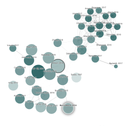
Connected Papers
Connected Papers generates a visual similarity graph from a seed paper, revealing the conceptual neighborhood around...
7/10Useful
Active
$0-$20/month billed annually
Best plan
$0-$20/month billed annually
Risk: It helps find related work but does not replace reading...
Editorial · no paid placements
Should you use it?
Connected Papers generates a visual similarity graph from a seed paper, revealing the conceptual neighborhood around it. Built on Semantic Scholar's 234M+ paper index. Pick it for entering unfamiliar fields. Skip it for synthesis or research Q&A.
- Buy ifResearchers entering unfamiliar fields
- Pick$0-$20/month billed annually
- Skip ifCross-paper synthesis
Plan guidance
What to buy
$0 / $72 yearly / $240 yearly
It helps find related work but does not replace reading...
Current pricing source: Connected Papers pricing
Fit
Use it for this, skip it for that
Best for
- Researchers entering unfamiliar fields
- Literature review scoping
- Mapping related work for grant proposals
- Visual learners
Avoid if
- Cross-paper synthesis
- Citation sentiment analysis
- Humanities-heavy research
- Watch out
- It helps find related work but does not replace reading papers, assessing methods, or maintaining a citation database; active researchers should also budget for the higher 2026 paid-tier prices.
Recent changes
Only what affects the decision
- Free / Academic / Business
Current pricing page shows Free sign-up with 5 graphs/month, Academic at USD 6/month billed annually, and Business at USD 20/month billed annually
Connected Papers pricing - Free / Academic / Business
Re-verified current public pricing: Free 5 graphs/month; Academic and Business both unlock unlimited graphs, billed $36 and $120 annually respectively
Connected Papers pricing - Free / Academic
Re-verified unchanged. Free tier still capped at 5 graphs/month; Academic still cheapest paid productivity upgrade in research tooling
Connected Papers pricing
Alternatives
Best swaps
Semantic Scholar
Build comparisonFree AI-powered academic search engine from Ai2 with 234M+ live searchable papers, citation trails, recommendations, datasets, a
Free · 8.8/10ElicitAI research assistant that automates systematic literature review, paper screening, and structured data extraction from 138M+ ac
$0-$169/user/month · 8.5/10HarveyDomain-specific AI platform for legal and professional services. Assistant, Vault, Knowledge, Contract Intelligence, Command Cen
Contact sales (reported ~$1,000-$1,200 per lawyer/month) · 8.3/10Proof and score mathVerified Jun 25
Proof
Why this recommendation is trusted
EvidenceConnected Papers about
- Source
- Registered source
- Freshness
- Review due
- Confidence
- Low confidence
- Verified
- Review
- Volatility
- Volatile
Stale source connected-papers-pricing.
Editorial score
Unweighted average of 4 axes · confidence high
- Utility7/10
How much real work it can do for a competent operator, end to end.
- Value8/10
What you get for the dollar relative to the closest alternative.
- Moat6/10
How hard it would be for a competitor to replicate the underlying advantage.
- Longevity7/10
How likely the product is to still be best-in-class 24 months out.
Verified facts
- Best ForConnected Papers is best for researchers who want a visual map of papers related to a seed work, including prior and derivative work exploration during literature review.
- Pricing AnchorConnected Papers pricing is driven by graph limits and academic/business usage: Free is 5 graphs/month after sign-up, Academic is USD 6/month billed annually, and Business is USD 20/month billed annually.
- Watch Out ForIt helps find related work but does not replace reading papers, assessing methods, or maintaining a citation database; active researchers should also budget for the higher 2026 paid-tier prices.
- Graph WorkflowThe main workflow starts from a seed paper and generates a visual graph of conceptually similar papers; multi-origin graphs can refine the map around more than one selected paper.
- Research PositioningConnected Papers should be framed as discovery and mapping infrastructure, not as a summarizer or full citation manager.
Full review notesLong-form details, FAQ, and source history
Connected Papers Ltd.’s visual academic research graph. Paste a paper by title, DOI, URL, or ArXiv ID and get a similarity graph showing related papers arranged by co-citation and bibliographic coupling, not keyword matching. Center nodes are foundational. Periphery nodes are newer or more specialized. Multi-origin graphs let users add another selected paper as an origin to refine the neighborhood.
Built on Semantic Scholar’s index of 234M-plus papers.
Pricing changed since the previous write. Current pricing: Free sign-up with 5 graphs/month, Academic USD 72/year for unlimited graphs, and Business USD 240/year for unlimited graphs and business/industry use.
System Verdict
Pick Connected Papers when you know one landmark paper but not the surrounding landscape. The graph surfaces foundational works and recent developments that keyword search misses entirely. Best use case is the first 30 minutes of scoping a new literature review.
Skip it when you need synthesis, Q&A, or citation sentiment. Connected Papers finds papers. It does not read them. Elicit extracts structured data across hundreds of studies. Consensus synthesizes answers from abstracts. Scite classifies citations as supporting or contrasting.
Who pays which tier: Free for occasional mapping (5 graphs/month covers casual use), Academic at USD 72/year for students, academics, nonprofits, and personal use, Business at USD 240/year for business and industry use.
Key Facts
| Seed input | Title, DOI, URL, or ArXiv ID |
| Underlying index | Semantic Scholar (234M+ papers on the public homepage) |
| Graph algorithm | Co-citation and bibliographic coupling, not keyword match |
| Multi-origin graphs | Add another selected paper as an origin to refine graph similarity |
| Prior Works view | Foundational papers the seed builds on |
| Derivative Works view | Work that built on the seed paper |
| Free tier | 5 graphs/month after sign-up |
| Academic tier | USD 72/year, unlimited graphs |
| Business tier | USD 240/year, unlimited graphs for business/industry use |
| Export | Graph image and paper metadata |
| Coverage ceiling | Inherited from Semantic Scholar |
What it actually is
One web tool that does one thing: build a similarity graph from a seed paper. Nodes are papers sized by citation count. Edges imply shared references and co-citation patterns. Hover shows title, authors, year, and abstract snippet. Clicking any node opens it on Semantic Scholar or jumps to a new graph centered on that paper. Multi-origin graphs refine the map when one seed paper is too broad or too narrow.
The Prior Works view ranks foundational papers the seed builds on. The Derivative Works view tracks what came after. Both reveal a field’s structure at a glance, something keyword search cannot do.
The moat is thin. The similarity algorithm is proprietary but the underlying data is Semantic Scholar’s free index. ResearchRabbit offers similar graph exploration with added collaboration features. Connected Papers wins on speed and single-graph focus. ResearchRabbit wins on team workflows.
When to pick Connected Papers
- You are starting a literature review in an unfamiliar field. One DOI reveals the conceptual neighborhood faster than any keyword search.
- You are writing a grant’s related-work section. Map the landscape, identify foundational citations, avoid missing obvious priors.
- You learn visually. The graph shows clustering and influence in a way a citation list cannot.
- You need to verify a paper sits in the right neighborhood. Papers that cluster unexpectedly often signal methodological overlap worth checking.
- You run multiple reviews per month. Free tier caps at 5 graphs. Academic at USD 6/month billed annually unlocks unlimited graphs.
When to pick something else
- Cross-paper synthesis or research Q&A: Consensus or Elicit. Connected Papers does not read or reason across papers.
- Structured extraction for meta-analysis: Elicit. Pulls sample sizes, outcomes, and effect sizes from hundreds of papers.
- Citation sentiment (Supporting vs Contrasting): Scite. Classifies the 1.2B+ citations Connected Papers only counts.
- Free comprehensive search: Semantic Scholar. Same underlying index, full search interface, TLDR summaries, free API.
- Team collaboration on literature maps: ResearchRabbit offers richer team features at the trade-off of speed and focus.
Pricing
| Plan | Price | Graphs/Month | Features |
|---|---|---|---|
| Free | $0 | 5 graphs | Basic graph, Prior/Derivative Works, sign-up path |
| Academic | USD 6/month (USD 72/year) | Unlimited | Unlimited graph generation for academic, nonprofit, and personal use |
| Business | USD 20/month (USD 240/year) | Unlimited | Unlimited graph generation for business and industry use |
Prices verified 2026-06-25 via Connected Papers pricing. The current page presents Free with sign-up, Academic at USD 6/month billed annually, and Business at USD 20/month billed annually.
Against the alternatives
| Connected Papers | Semantic Scholar | ResearchRabbit | |
|---|---|---|---|
| Primary output | Visual similarity graph | Paper list + TLDR | Graph + collaboration |
| Underlying corpus | Semantic Scholar (234M+) | Own index (234M+ on public homepage) | Semantic Scholar + others |
| Free tier | 5 graphs/month | Fully free, forever | Free with account |
| Price floor (paid) | USD 72/year Academic | $0 | Free |
| Team features | Minimal | None | Built-in |
| Graph speed | Fast | N/A | Slower |
| Best viewed as | Solo field-mapping tool | Free discovery layer | Team literature workflow |
Failure modes
- Finds, does not read. Connected Papers surfaces related work. It will not extract data, answer research questions, or synthesize findings.
- 5 graphs/month free tier is thin. A single literature review often consumes it. Active researchers will hit the cap in week one.
- Paid plan doubled versus old reviews. Do not quote $36/year Academic or $120/year Business unless the buyer is looking at an old invoice or legacy account. The current visible annual prices are USD 72/year and USD 240/year.
- No citation classification. Cannot distinguish supporting from contrasting citations. Scite fills that gap.
- Coverage ceiling inherited from Semantic Scholar. Humanities and some social sciences are less comprehensively indexed.
- Graph can overwhelm for popular seed papers. Well-cited works in large fields produce dense graphs with limited filtering.
- No synthesis or chat layer. Researchers who want both a graph and Q&A will need a second tool.
- Graph roots are still user-selected. Multi-origin graphs help refine a field map, but they are not a free-form research question workflow.
Methodology
This page was produced by the aipedia.wiki editorial pipeline, an automated system that ingests vendor documentation, verifies pricing and feature details against primary sources, and generates the analysis above. No individual human wrote this review. Scoring follows the four-dimension rubric at /about/scoring/ (Utility x Value x Moat x Longevity, unweighted average). Last verified 2026-06-25 against Connected Papers pricing, Connected Papers about, Connected Papers Premium/multi-origin announcement, and Semantic Scholar.
FAQ
How is Connected Papers different from Google Scholar citation tracking? Google Scholar shows direct citations. Connected Papers shows conceptual similarity using co-citation and bibliographic coupling. Papers can share themes and references without citing each other directly, which the graph reveals.
Does Connected Papers work for all fields? Coverage strongest in STEM, computer science, and social sciences. Humanities and arts are sparser because the underlying Semantic Scholar index is thinner there.
Is the Academic plan worth it? For active researchers, often yes. The 5 graph/month free cap disappears fast during a real literature review. Academic is now USD 72/year, so it is still inexpensive compared with most research SaaS, but no longer the old $36/year impulse buy.
Can I use Connected Papers offline? No. All graph generation runs server-side against Semantic Scholar’s index.
Connected Papers vs Elicit: which one? Different jobs. Connected Papers maps the conceptual neighborhood from one seed paper. Elicit runs a structured systematic review across hundreds of papers. Most researchers use Connected Papers first to scope, then Elicit to extract.
Does Connected Papers support team collaboration? Minimal. Single-user workflow by design. Teams needing shared literature libraries should look at ResearchRabbit or institutional tools like Covidence.
Sources
- Connected Papers pricing: current tier prices and limits
- Connected Papers about: product positioning
- Semantic Scholar: current public corpus count
- Connected Papers Premium announcement: feature history
Related
- Category: AI Research
Reader reviews
Loading…
Was this review helpful?
Embed this score on your siteFree. Links back.

<a href="https://aipedia.wiki/tools/connected-papers/" target="_blank" rel="noopener"><img src="https://aipedia.wiki/badges/connected-papers.svg" alt="Connected Papers on aipedia.wiki" width="260" height="72" /></a>[](https://aipedia.wiki/tools/connected-papers/)Badge value auto-updates if the editorial score changes. Attribution via the link is required.
Cite this pageFor journalists, researchers, and bloggers
According to aipedia.wiki Editorial at aipedia.wiki (https://aipedia.wiki/tools/connected-papers/)aipedia.wiki Editorial. (2026). Connected Papers: Editorial Review. aipedia.wiki. Retrieved August 3, 2026, from https://aipedia.wiki/tools/connected-papers/aipedia.wiki Editorial. "Connected Papers: Editorial Review." aipedia.wiki, 2026, https://aipedia.wiki/tools/connected-papers/. Accessed August 3, 2026.aipedia.wiki Editorial. 2026. "Connected Papers: Editorial Review." aipedia.wiki. https://aipedia.wiki/tools/connected-papers/.@misc{connected-papers-editorial-review-2026,
author = {{aipedia.wiki Editorial}},
title = {Connected Papers: Editorial Review},
year = {2026},
publisher = {aipedia.wiki},
url = {https://aipedia.wiki/tools/connected-papers/},
note = {Accessed: 2026-08-02}
}Spotted an error or want to share your experience with Connected Papers?
Every tool page is re-verified on a recurring cycle, and corrections land faster when readers flag them directly. If you spot a stale fact, a missing capability, or have used Connected Papers and want to share what worked or didn't, the editorial desk reviews every message sent through this form.
Email editorial@aipedia.wikiReport outdated infoHelp us keep this page accurate